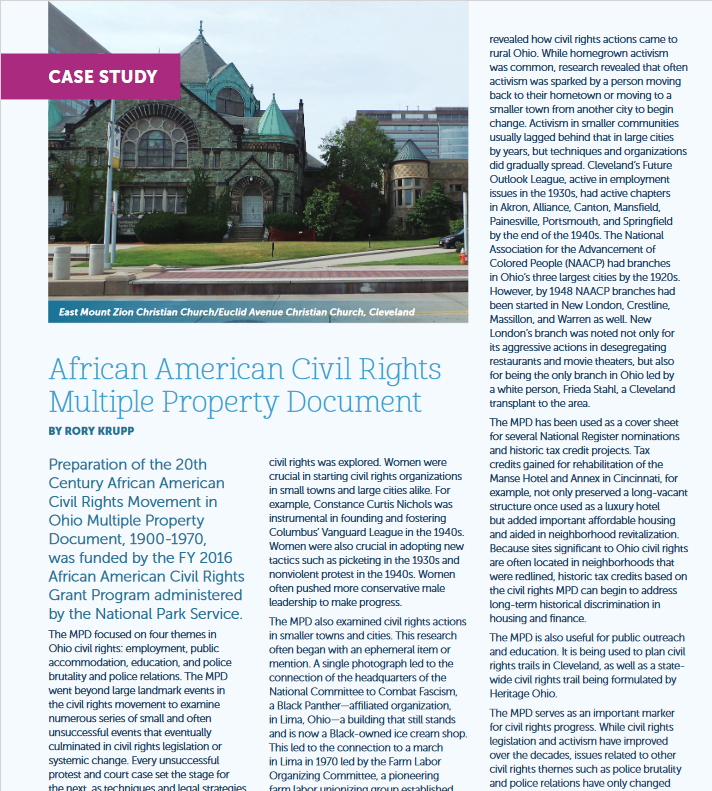
We have two case studies in the 2023-2030 Ohio State Historic Preservation Plan. Our “African American Civil Rights Movement Multiple Property Document, 1900-1970”, examines Ohio’s civil right’s history through the themes of public accommodations, education, employment, and police relations. The multiple property document provides a historic context and registration guidelines for National Register of Historic Places nominations.
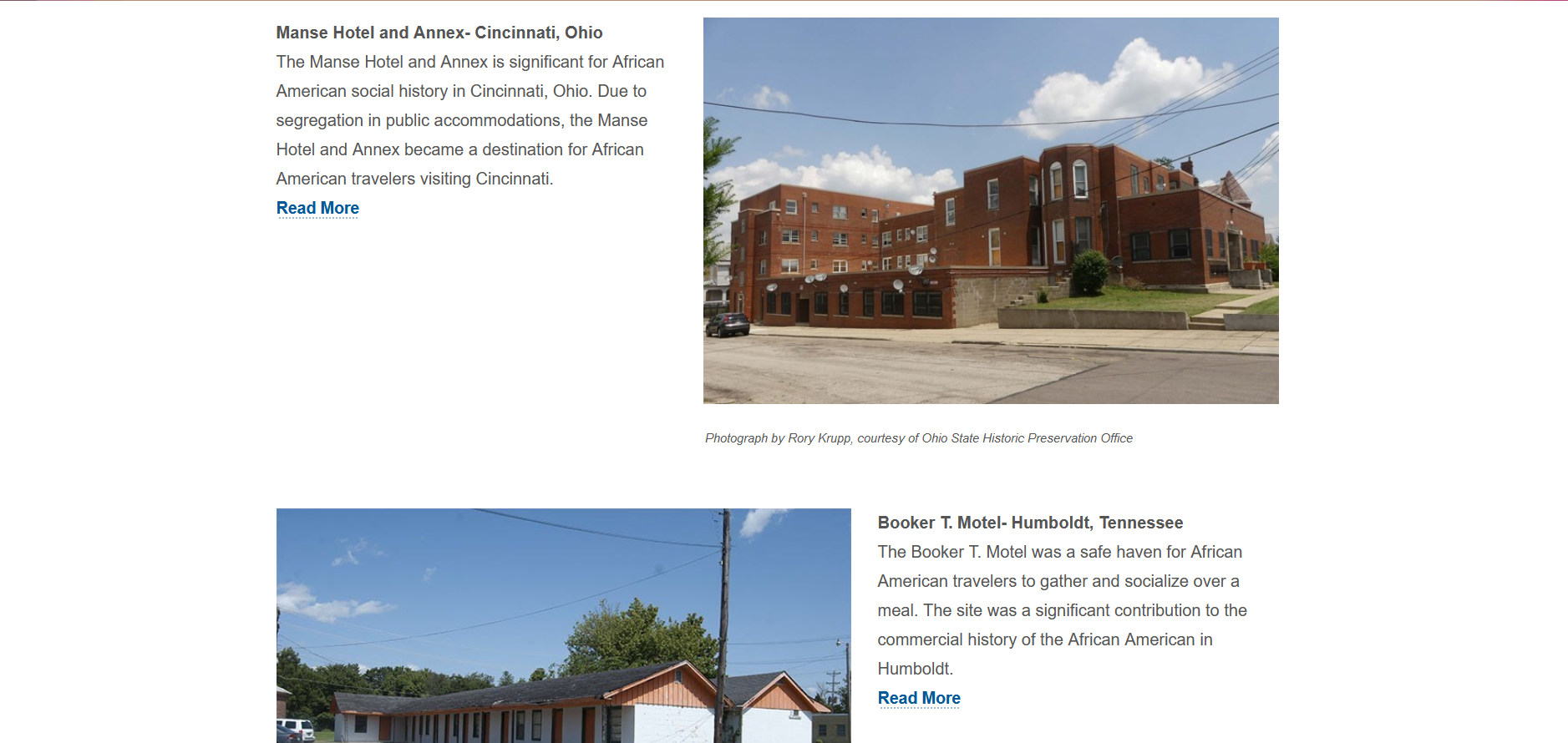
Owen & Eastlake prepared the National Register of Historic Places nomination for the Manse Hotel and Annex in Cincinnati, Ohio. The original plan was the building’s demolition. But research into the building’s past indicated it was an important part of Cincinnati’s Black history. The site’s rich history and rarity of its type overcame the building’s problematic integrity. Local historic designation and the National Register listing enabled state and federal historic tax credits to be used for the building’s adaptive reuse.
The entire Ohio State Historic Preservation Plan is available here:
Projects that Owen & Eastlake completed in 2022 included historic contexts, historic districts, and architectural surveys. Through our projects we explored mid-century modern development trends, architectural styles, and community development. We also expanded the community narrative and the concept of historic integrity in neighborhoods that suffered from historic disinvestment.
Historic Context for Jefferson City, Missouri
The Central Motorist Bank, a 1962 Skidmore, Owings & Merrill design in downtown Jefferson City.
Owen & Eastlake researched and wrote a historic context for Jefferson City, Missouri, to assist the city in planning with historic preservation in mind. The context explored historic moments in the city and how the resulting changes were evidenced in the built environment. It also explored race relations throughout Jefferson City’s history, including the city’s relationship with its HCBU, Lincoln University; segregation and its effects on neighborhoods; and the city’s efforts at revitalization through urban renewal.
The project was funded by a National Park Service Historic Preservation Fund grant and the City of Jefferson.
Joplin East Town Historic District Nomination, Joplin, Missouri
Placing historic integrity in context allowed this 1870s commercial building to become a contributing propertyin the historic district.
Owen & Eastlake prepared a National Register nomination for East Town, the first commercial district in the zinc-mining town of Joplin, Missouri. Joplin also wanted to recognize African American contributions to the city’s early history and the history of southwestern Missouri, and the historic district’s role in the city’s Black history. These were often difficult subjects—they were known, but had not been readily discussed. In 1903, a lynching led to the expulsion of some African American residents, but the Black community responded: the 1904 Emancipation Day festivities drew more than 5,000 African American residents and visitors to celebrate their heritage. The nomination also explored Joplin’s racial segregation and reactions to it.
The Joplin Globe, in a 2022 editorial, welcomed the state’s decision to advance the nomination, noting, “East Town’s is both a sad story, recalling as it does Joplin’s tragic history with racial violence and segregation, and an inspirational one, recalling triumphs of Joplin’s Black community.” It went on to state, “Both the suffering and the resilience of East Town are important parts of Joplin’s story that we hope are not ‘forgotten’ any longer.”
The project was funded by a National Park Service Historic Preservation Fund grant and the City of Joplin.
Evanston Historic District, Cincinnati, Ohio
A neighborhood business district in the Evanston neighborhood is primed for revitalization.
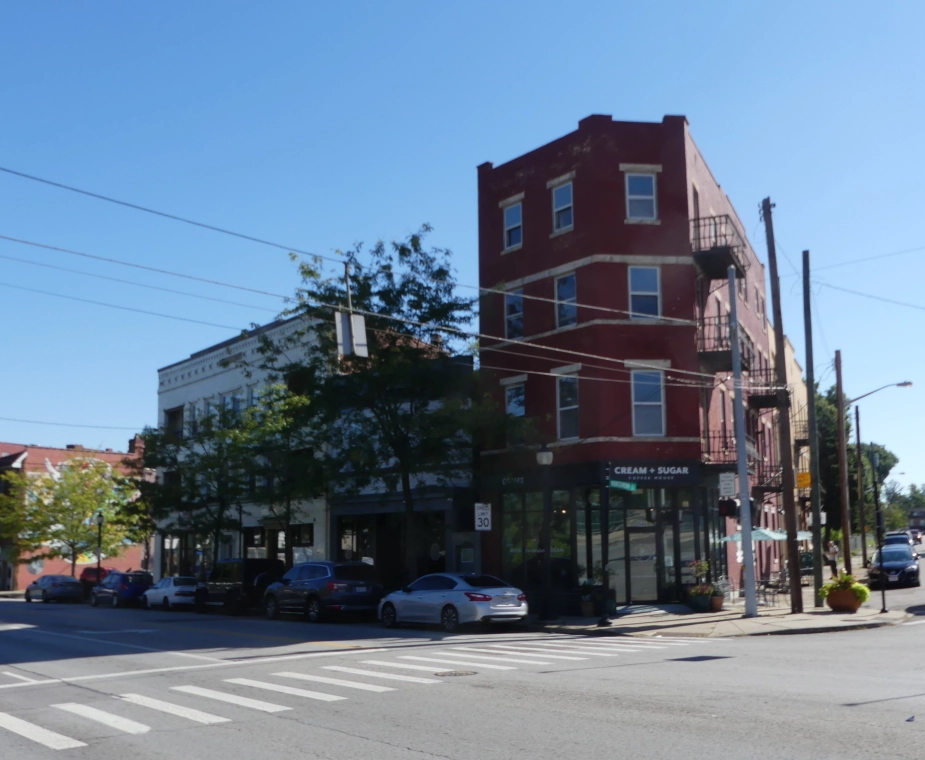
Owen & Eastlake prepared a National Register nomination for the Evanston neighborhood in Cincinnati, Ohio. The district nomination explored demographic change in Cincinnati with a focus on Evanston. Founded at the turn of the nineteenth century, Evanston was a German-flavored suburb that by the 1960s had a predominantly African American population. The nomination explored how this change played out in a neighborhood business district. A strip of commercial and residential buildings that originally housed white professionals and businesses gradually came to house African American businesses and professionals, a microcosm of Cincinnati’s demographic changes as a city. The district was nominated in pursuit of state and federal historic tax credits to advance economic revitalization.
The Memorial Park and Old Town North and East Neighborhoods, Kirksville, Missouri
A bungalow in the East Town neighborhood.
Owen & Eastlake conducted a reconnaissance architectural survey of in Kirksville, Missouri, that inventoried 298 properties in the East Town residential neighborhood and placed it in context through a short history of its beginnings in the late nineteenth century and changes through the twentieth century. The survey recommended a historic district and several individual National Register nominations. The project was funded by a National Park Service Historic Preservation Fund grant and the City of Kirksville.
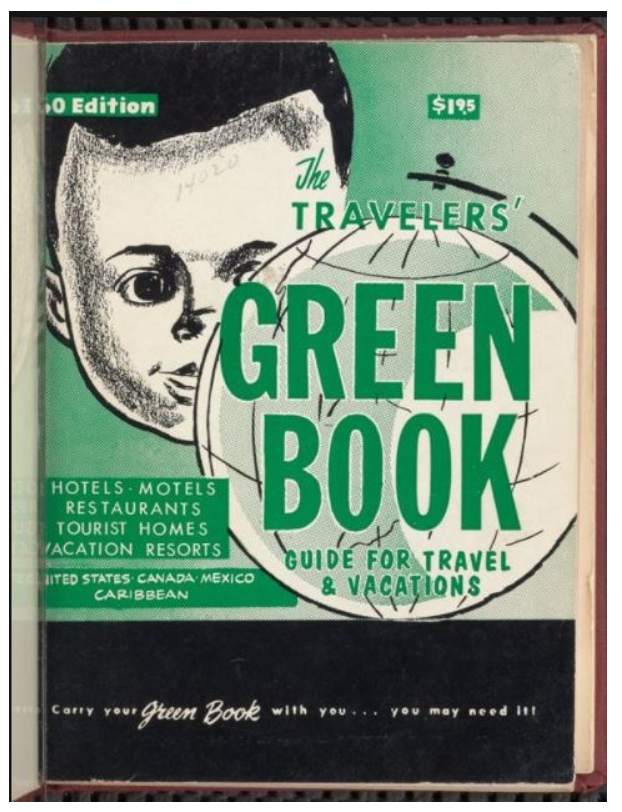
The National Park Service has published an article that details Green Book sites that included in the National Register. Victor Green published the Green Book as a travel guide for African Americans to eat, rest and travel without the threat of prejudice and sometimes violence. Our work on the Manse Hotel and Annex is featured.
The Manse Hotel and Annex was an African American owned luxury hotel in Cincinnati.
Our 2018 Multiple Property Document about 20th century African American civil rights is being used as the basis for a statewide civil rights tour by Heritage Ohio.
We also prepared the National Register nomination for the Manse Hotel. It was fascinating thing of Frank Robinson having breakfast before Cincinnati Reds ballgames and the fact that James Brown may have stayed there at the same time. What a potential breakfast conversation!





 Owen & Eastlake ltd